
- April 29, 2026
- 356
- Business
Starting a business in the UAE is one of the best decisions an entrepreneur can make — the country offers 0% personal income tax, world-class infrastructure, and a gateway to 2 billion consumers. But before you can legally operate, open a bank account, sponsor visas, or sign government contracts, you need one thing: a UAE trade license.
This guide covers everything in one place — what most other guides skip, including hidden costs, emirate-by-emirate comparisons, the renewal process, and the most common (and expensive) mistakes first-time applicants make.
1. What is a Trade License in the UAE?
A trade license (also called a business license) is an official government permit that authorizes a company to conduct specific commercial activities within the UAE. It is issued by the relevant authority depending on where your business is located — either the Department of Economic Development (DED) for mainland businesses, or the respective Free Zone Authority for free zone companies.
Every UAE trade license contains the following key information:
- Company legal name and trading name
- Approved business activities
- Jurisdiction (Mainland or Free Zone name)
- Legal structure (LLC, Sole Establishment, FZE, etc.)
- Registered office address
- Validity period (1 year, must be renewed annually)
💡 Key Fact: A UAE trade license is valid for exactly one year from the date of issue. If you do not renew it on time, you face fines of AED 250–1,000 per month of delay, and your license can be cancelled.
2. Why You Must Have a Trade License
Operating without a valid trade license in the UAE is illegal and carries serious consequences. Here is why a trade license is non-negotiable:
- Legal compliance: Without it, you are operating illegally and can face heavy fines, business closure, or deportation.
- Corporate bank account: No UAE bank will open a business account without a valid trade license.
- Visa sponsorship: You cannot sponsor employee or dependent visas without a valid license.
- Government contracts: All government tenders require a valid mainland trade license.
- Client trust: Major clients and corporate partners will ask for your trade license number before signing contracts.
- VAT registration: If your annual revenue exceeds AED 375,000, you must register for VAT, which requires a trade license.
3. Types of Trade Licenses in the UAE
The UAE issues several categories of trade licenses depending on what your business does. Choosing the wrong type is a very common and costly mistake.
| License Type | What It Covers | Examples | Issued By |
|---|---|---|---|
| Commercial License | Buying, selling, importing, exporting goods | Retail, trading, logistics, brokerage | DED / Free Zone |
| Professional License | Skilled services and consultancy | IT consulting, law, accounting, engineering | DED / Free Zone |
| Industrial License | Manufacturing, processing, production | Food production, textile, furniture | DED / Free Zone |
| General Trading License | Trading a wide variety of goods | Multi-category import/export businesses | DED / Free Zone |
| E-Commerce License | Online selling of goods and services | Online stores, digital services, dropshipping | DED / Free Zone |
| Tourism License | Hospitality, travel, events | Hotels, travel agencies, tour operators | DTCM / Free Zone |
| Agricultural License | Farming, aquaculture, food processing | Farms, nurseries, aquaculture | MOCCAE / DED |
| Media License | Content creation, publishing, broadcasting | Advertising agencies, production houses | Dubai Media / SHAMS |
| Craftsmanship License | Skilled trades and artisanal work | Carpentry, plumbing, jewelry making | DED |
⚠️ Important: Your approved business activities are legally binding. You can only conduct the activities listed on your license. Doing business outside those activities — even similar ones — is a legal violation. You can add or change activities later, but there is a fee.
4. Mainland vs Free Zone vs Offshore: Full Comparison
This is the most important decision you will make when setting up a business in the UAE — and it is the question most guides answer poorly. Here is a complete, honest comparison:
| Retail, restaurants, and local service businesses | Mainland | Free Zone | Offshore |
|---|---|---|---|
| Foreign Ownership | 100% (most activities, since 2021 reforms) | 100% | 100% |
| Trade within UAE | ✅ Unrestricted | ⚠️ Via distributor only | ❌ Not allowed |
| Office Requirement | Physical office (Ejari required) | Flexi-desk or virtual office available | No physical office needed |
| Government Contracts | ✅ Eligible | ❌ Generally not eligible | ❌ Not eligible |
| Visa Eligibility | ✅ Yes | ✅ Yes | ❌ No UAE visa |
| Bank Account in UAE | ✅ Easy | ✅ Possible | ⚠️ Difficult |
| Setup Cost | AED 20,000–50,000+ | AED 4,888–30,000 | AED 15,000–25,000 |
| Setup Speed | 1–3 weeks | 1–5 days | 1–2 weeks |
| Corporate Tax | 9% on profits above AED 375,000 | 0% if qualifying free zone entity | Varies |
| Best For | Retail, restaurants, local service businesses | Consultants, freelancers, online businesses | Holding companies, international trading |
💡Quick Rule: If your customers are primarily inside the UAE, go Mainland. If you serve international clients or work online, a Free Zone will save you money and time.
5. Step-by-Step: How to Get a Trade License in the UAE
The process is similar for both the Mainland and the Free Zone, with some differences. Here is the complete sequence:
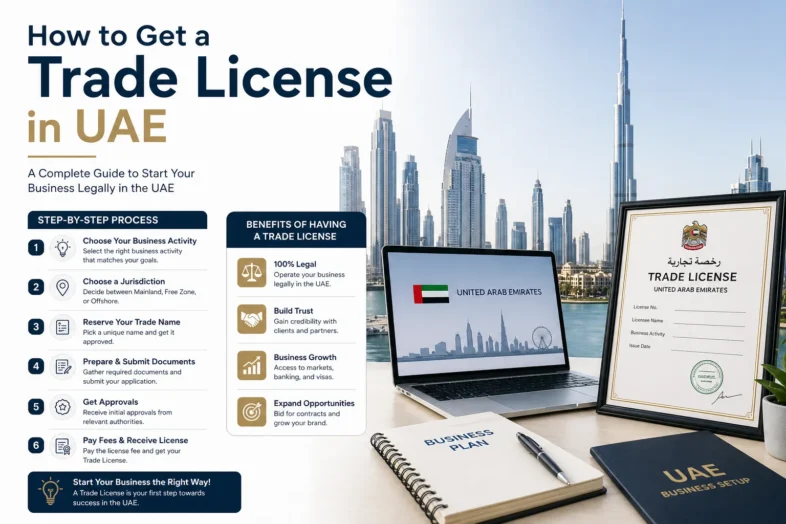
- Choose Your Business Activity: Select the exact commercial activities your business will conduct. Each activity is linked to a specific license category. You can choose multiple activities under one license, but fees increase with each addition. Use the DED’s official activity list for the Mainland, or your chosen Free Zone’s activity list.
- Decide Your Jurisdiction: Mainland, Free Zone, or Offshore. Based on your business model, target market, and budget, choose where to incorporate. This decision affects your costs, restrictions, and visa eligibility significantly (see comparison table above).
- Choose a Legal Structure for Mainland: LLC (most common), Sole Establishment, Civil Company, or Branch. For Free Zone: FZE (1 shareholder) or FZ LLC (2–50 shareholders). Your legal structure affects liability, ownership, and minimum capital requirements.
- Reserve Your Trade Name. Submit 3–5 name options (in order of preference) to the DED or Free Zone authority. Names must not be offensive, already registered, or contain restricted words (e.g., “Emirates,” “UAE,” “National” require special approval). Trade name reservation costs approximately AED 200–620 on the Mainland.
- Apply for Initial Approval. Submit your initial application with basic documents (passport copies, proposed activities). The authority reviews whether your activity is permitted and grants preliminary approval. This does not mean your business is open — it just confirms you can proceed.
- Secure a Business Address / Office Space. For the Mainland, you need a physical office with an Ejari (registered tenancy contract). For Free Zones, a flexi-desk or virtual office is usually sufficient. This is a step many people forget — and it is mandatory before final approval.
- Get External Approvals (If Required). Certain activities need approval from additional regulatory bodies before license issuance. Healthcare businesses need Dubai Health Authority (DHA) approval. Food businesses need Municipality clearance. Financial services need Central Bank or SCA approval. This step can add 1–4 weeks to your timeline.
- Submit Final Documents and Pay Fees. Submit your complete document package through the online portal (DED’s Invest in Dubai portal for Mainland, or the Free Zone’s online system). Pay all applicable government fees online.
- Receive Your Trade License. Once approved, your trade license is issued digitally. You can download it immediately. For some Free Zones, this happens within 24–48 hours of payment. For the Mainland, it typically takes 3–7 working days after all approvals are in place.
- Apply for Visas (If Needed)With your trade license issued, you can now apply for investor/owner visas, employee visas, and dependent visas. Visa processing requires a physical visit for biometrics and medical tests. Budget 2–3 weeks for visa completion.
- Open a Corporate Bank Account. Use your trade license, Memorandum of Association (MOA), and Emirates ID to open a corporate bank account. Allow 2–6 weeks for this process, as UAE banks have strict compliance requirements. Having a business plan ready significantly speeds this up.
6. Documents Required for a UAE Trade License
| Document | Mainland | Free Zone | Notes |
|---|---|---|---|
| Passport copy (all shareholders) | ✅ | ✅ | Must be valid for 6+ months |
| UAE Visa copy / Emirates ID | ✅ (if resident) | ✅ (if resident) | Non-residents can still apply |
| Passport-size photographs | ✅ | ✅ | White background, recent |
| Proof of address (home country) | ✅ | ✅ | Utility bill or bank statement |
| No Objection Certificate (NOC) | ✅ (if currently employed) | Sometimes | From current UAE employer |
| Business plan | Some activities | Some activities | Required for financial services, healthcare |
| Ejari (office tenancy contract) | ✅ Mandatory | ❌ Not usually required | Mainland requires physical office |
| MOA / AOA (drafted by authority) | ✅ | ✅ | Legal entity formation document |
| Educational qualifications | For professional licenses | For professional licenses | Must be attested |
7. Real Costs(Including Hidden Fees)
This is where most guides fail you. They show you the headline price but hide the true cost. Here is a complete breakdown of every fee you should budget for:
Mainland Trade License — Full Cost Breakdown
| Fee Item | Approximate Cost (AED) | Notes |
|---|---|---|
| Trade name reservation | 200–620 | One-time |
| Initial approval fee | 150–300 | One-time |
| Trade license fee | 10,000–25,000 | Annual, varies by activity |
| Physical office (Ejari) | 12,000–60,000+ | Annual rent |
| Ejari registration fee | 155–220 | Annual |
| MOA notarization | 1,000–2,500 | One-time |
| Municipality fees | 5% of annual rent | Annual |
| Investor visa (per person) | 3,800–6,500 | Includes medical + Emirates ID |
| External approvals (if needed) | 500–5,000 | Sector-specific |
| Total Estimate (Year 1) | 30,000–100,000+ | Depends on office rent and activity |
Free Zone Trade License — Full Cost Breakdown
| Depends on the free zone and visa needs | Approximate Cost (AED) | Notes |
|---|---|---|
| License fee (base package) | 4,888–30,000 | Varies by free zone |
| Flexi-desk / virtual office | Usually included in package | Some charge AED 3,000–8,000 separately |
| Registration fee | 500–2,000 | One-time |
| Investor visa (per person) | 3,800–6,500 | Includes medical + Emirates ID |
| Establishment card | 350–700 | Annual |
| Additional business activities | 500–1,000 each | Beyond included activities |
| Total Estimate (Year 1, 1 Visa) | 10,000–40,000 | Depends on free zone and visa needs |
⚠️ Hidden Costs Most Guides Don’t Mention: Bank account minimum balance requirements (AED 25,000–250,000 depending on the bank). Document attestation and translation fees (AED 500–2,500). PRO (Public Relations Officer) service fees if you outsource visa/document processing (AED 2,000–5,000/year). Medical insurance (mandatory for visa holders): AED 600–2,500 per person annually. Corporate tax registration fee (if applicable). Business setup consultant fees (AED 1,500–5,000) if you use a consultant.
8. Emirate-by-Emirate Cost Comparison
The UAE offers more than 45 free zones across its seven emirates, each with different pricing, benefits, and target industries. Understanding these differences can help entrepreneurs choose the most cost-effective option based on their business needs. Below is a detailed comparison of the most affordable business setup options in each emirate.
Ajman (Cheapest UAE Option)
Ajman is widely considered the most budget-friendly emirate for business setup in the UAE.
Key Details:
- Cost: AED 4,888
- Popular Zones: Ajman NuVenture / Ajman Media City
- Package Type: Zero-visa trade license
Benefits:
- 100% foreign ownership
- Fast and simple registration process
- Ideal for startups and small businesses
Limitations:
- Limited banking options
- Lower international brand recognition
Ras Al Khaimah (RAKEZ)
RAKEZ is one of the most reliable and business-friendly free zones in the UAE, especially for industrial and manufacturing businesses.
Key Details:
- Cost: AED 6,000
- Package: Basic license with flexi-desk
Benefits:
- Instant online license approval
- No need for a physical visit
- Strong support for manufacturing businesses
- Better banking access compared to smaller emirates
Sharjah (SHAMS)
Sharjah Media City (SHAMS) is popular among freelancers and creative professionals.
Key Details:
- Cost: AED 5,500 – AED 8,000
- Focus: Media, marketing, and creative industries
Benefits:
- 100% remote setup process
- Freelancer-friendly packages
- Close proximity to Dubai
- No paid-up capital requirement
Umm Al Quwain (UAQ FTZ)
UAQ Free Trade Zone offers one of the simplest and most affordable setups, especially for online businesses.
Key Details:
- Cost: AED 5,000
- Focus: E-commerce and service-based businesses
Benefits:
- Very low setup cost
- Easy online application process
- Allows multiple business activities
Limitations:
- Lower prestige compared to Dubai or RAK
Dubai Free Zones (IFZA / Meydan)
Dubai free zones provide strong credibility and global recognition while still offering relatively affordable entry options.
Key Details:
- Cost: AED 12,500 – AED 12,900
- Zones: IFZA, Meydan
Benefits:
- Dubai business address
- Access to international markets
- Strong banking support
- Over 2,000 business activities available
Best For:
- Entrepreneurs targeting global clients
Dubai Mainland (DET)
Dubai Mainland offers full flexibility and access to the UAE local market but comes at a higher cost.
Key Details:
- Cost: AED 20,000 – AED 50,000+
- Authority: Department of Economy and Tourism (DET)
Benefits:
- Ability to trade anywhere in the UAE
- Access to government contracts
- No restrictions on business location
Requirements:
- Physical office space required
Best For:
- Businesses targeting local UAE customers and large-scale operations
9. Realistic Timeline: How Long Does It Actually Take?
| Stage | Free Zone | Mainland (Dubai) |
|---|---|---|
| Trade name reservation | 1–2 hours | 1–3 days |
| Initial approval | Same day | 1–5 days |
| License issuance | 1–5 working days | 3–7 working days |
| External approvals (if needed) | 1–4 weeks | 1–6 weeks |
| Visa processing (entry permit to Emirates ID) | 2–3 weeks | 2–3 weeks |
| Corporate bank account | 2–6 weeks | 1–4 weeks |
| Total (standard setup, no complications) | 1–3 weeks | 2–5 weeks |
📌 Note: Some Free Zones (RAKEZ, SHAMS, UAQ) now offer instant online licenses that are issued within minutes of payment for eligible activities. However, the visa process always takes 2–3 weeks regardless of how quickly the license was issued, as it requires in-person medical tests and biometrics.
10. How to Renew Your UAE Trade License
Every UAE trade license expires after one year and must be renewed annually. This is a step that almost no competitor guide covers properly — but missing your renewal deadline is one of the most expensive mistakes you can make.
Renewal Process (Mainland)
- Renew your office tenancy contract (Ejari) — this must be done first
- Log in to the DED portal (Invest in Dubai) or use the Dubai Now app
- Submit renewal application (60 days before expiry recommended)
- Pay renewal fees (similar to the original license fee)
- Receive a renewed license digitally
Renewal Process (Free Zone)
- Log in to your Free Zone’s online portal (usually 30–60 days before expiry)
- Confirm business details and activities
- Pay renewal fee (usually the same as the annual license fee)
- Receive renewed license — often instantly
⚠️ Late Renewal Penalties: If you miss your renewal date: AED 250 fine for the first month, increasing by AED 250 per month after that. After 6 months of inactivity, authorities can blacklist your company, cancel your visas, and bar you from opening businesses in the UAE. Renew at least 30 days before expiry.
11. Can Non-Residents Get a UAE Trade License?
Yes — and this is one of the most frequently asked questions that most guides do not address clearly.
Non-UAE residents (people who do not live in the UAE) can obtain a UAE trade license, particularly through Free Zones. Here is what you need to know:
- Free Zone licenses for non-residents: Zones like RAKEZ, UAQ FTZ, IFZA, and SHAMS allow complete online registration without visiting the UAE. You only need a valid passport.
- Visa: You cannot get a UAE residence visa without physically visiting the UAE for biometrics and medical tests. A license alone does not give you a visa.
- Bank account: Opening a UAE corporate bank account remotely is possible with some banks (e.g., through fintech solutions), but most UAE banks require an in-person visit.
- Mainland licenses for non-residents: Generally more complex without a UAE visa, but technically possible with the right setup.
✅ Best Free Zones for Non-Residents RAKEZ (Ras Al Khaimah) — fully online, AED 6,000+. SHAMS (Sharjah) — 100% remote, AED 5,500+. UAQ FTZ (Umm Al Quwain) — online setup, AED 5,000+. IFZA (Dubai) — remote possible, AED 12,900+. Meydan Free Zone (Dubai) — online, AED 12,500+.
12. Freelance Permit vs Trade License: Which Do You Need?
Many people starting out do not need a full trade license. The UAE offers a freelance permit (also called a freelance license) specifically for individual service providers. Here is how they compare:
| Factor | Freelance Permit | Trade License |
|---|---|---|
| Who can get it | Individual (1 person) | 1 or more shareholders |
| Employees | Cannot sponsor employees | Can sponsor multiple employees |
| Activities | Limited (creative, tech, consulting) | Wide range (commercial, industrial, etc.) |
| Cost | AED 1,370–7,500 | AED 4,888–50,000+ |
| Visa eligibility | ✅ Yes (for yourself) | ✅ Yes (for self and employees) |
| Corporate bank account | Some banks (limited) | All banks |
| Best for | Solo consultants, designers, writers | Any business with employees or physical trade |
Dubai’s E-Trader license (for home-based online businesses) starts at just AED 1,370 and is ideal for individuals selling products or services online without needing a separate office.
13. The 7 Most Common (and Expensive) Mistakes to Avoid
- ❌Choosing the wrong jurisdiction based only on cost. The cheapest license is not always the best. A license from a less-recognized free zone can make it very hard to open a UAE bank account — which makes your license essentially useless. Balance cost with banking accessibility, especially if you need a UAE corporate account.
- ❌Not listing all your business activities upfront. Many people list the minimum activities to save fees, then discover they need to add more later. Each addition costs money and takes time. Think through everything your business might do and add it from the start.
- ❌Ignoring the Mainland restriction on Free Zone businesses. Free Zone companies cannot sell directly to mainland UAE customers without either a mainland distributor or a separate mainland company. If your market is UAE-based consumers, a Free Zone license severely limits you.
- ❌Missing the renewal deadline. Fines start immediately and escalate monthly. After 6 months, the consequences become severe — including company cancellation and visa issues. Set a calendar reminder 60 days before your expiry date.
- ❌Not budgeting for hidden costs. The license fee is just the beginning. Bank minimum balances, visa medical fees, insurance, office rent, Ejari, municipality fees, and attestation costs can double your total first-year spend compared to the advertised price.
- ❌Choosing a trade name that violates UAE naming rules. Names containing religious references, government-related terms, or names of world leaders are prohibited. Names that are offensive, misleading, or too similar to existing companies will be rejected — wasting your time and application fees.
- ❌Assuming a Free Zone license equals a UAE residence visa. The license and the visa are two separate processes. The license gives you the right to apply for a visa — it does not grant you residency automatically. You still need to physically visit the UAE for medical tests and biometrics to complete your visa.
14. Frequently Asked Questions
How much does a UAE trade license cost?
The cost ranges from AED 4,888 (cheapest Free Zone, zero-visa) to AED 50,000+ (Mainland with physical office and visas). For most small businesses, a realistic first-year total budget including visas is AED 15,000–40,000 for Free Zone and AED 35,000–80,000 for Mainland. Always budget 20–30% extra for hidden costs.
What is the cheapest trade license in the UAE?
The cheapest UAE trade license is from Ajman NuVenture Free Zone or Ajman Media City, starting at AED 4,888 for a zero-visa package. For Dubai specifically, Meydan Free Zone offers the lowest starting price at AED 12,500.
Can I get a UAE trade license without visiting the UAE?
Yes. Many Free Zones — including RAKEZ, SHAMS, UAQ FTZ, and IFZA — allow complete online registration without visiting the UAE. You only need a passport copy. However, if you want a UAE residence visa, you must visit in person for medical tests and biometrics.
How long does it take to get a UAE trade license?
Free Zone licenses can be issued within 1–5 working days, and some instant-license zones issue them within minutes. Mainland licenses typically take 3–7 working days. However, if your activity requires external regulatory approvals (healthcare, finance, food), add 2–6 weeks to the timeline.
Do I need a local sponsor for a UAE trade license?
No — not for most businesses. Since the 2021 UAE Companies Law reforms, foreign investors can own 100% of most Mainland business activities without a local sponsor. Free Zones have always allowed 100% foreign ownership. A local sponsor is still required for certain restricted activities (e.g., oil drilling, security services, some professional activities).
How do I renew a UAE trade license?
For Mainland: renew your Ejari (office tenancy) first, then submit a renewal application through the DED portal and pay the renewal fees. For Free Zone: log into your Free Zone’s online portal and complete the renewal process online. Start the renewal process at least 30 days before your expiry date to avoid fines.
What happens if I operate without a trade license in UAE?
Operating without a valid UAE trade license is a criminal offense. Penalties include heavy fines (starting at AED 50,000), immediate business closure, confiscation of goods, and possible deportation for expatriates. There are no exceptions — even small home-based businesses need a license.
Can a UAE trade license be cancelled?
Yes. If you decide to close your business, you must formally cancel your trade license with the issuing authority. You must also cancel all employee visas, close your Ejari, and settle any outstanding dues. Abandoning a license without proper cancellation can result in outstanding fines and bans from future business setup in the UAE.
Is a Free Zone license or a Mainland license better?
It depends entirely on your business model. Free Zone is better if you work with international clients, offer services online, or want a lower-cost, faster setup. Mainland is better if you need to sell directly to UAE consumers, open a physical retail location, or bid for government contracts. Many businesses eventually set up both — starting with Free Zone and expanding to the Mainland as they grow.
Can I change my trade license activity after it is issued?
Yes. You can add, remove, or change business activities on an existing license. For the Mainland, this requires submitting a modification request through the DED portal and paying a modification fee (AED 500–2,000 typically). For Free Zones, the process is similar through their online system. Major changes to your legal structure require more extensive paperwork.
Ready to Get Your UAE Trade License?
Use this guide to plan your setup — know your costs, choose the right jurisdiction, and avoid the most expensive mistakes before you apply.
📌 Save this page for reference — costs and regulations are reviewed and updated regularly.