

- September 26, 2026
- 15
- Doctors
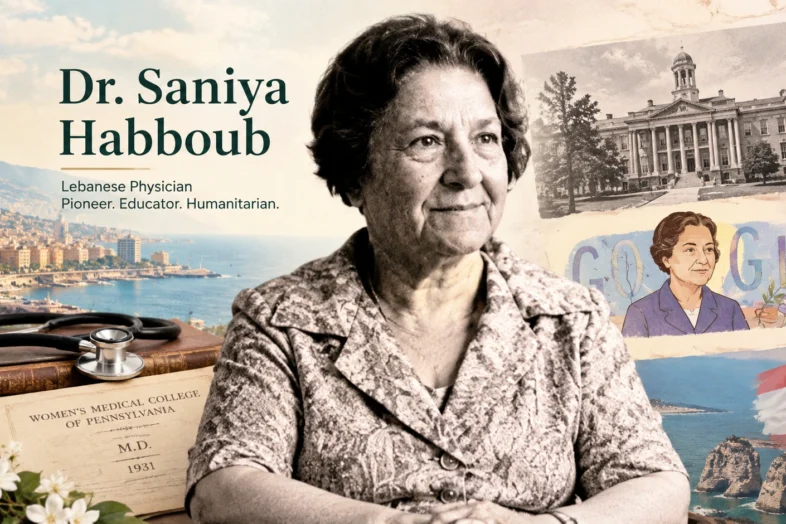
Dr. Saniya Habboub was a Lebanese physician who earned her medical degree in gynecology and obstetrics from the Women’s Medical College of Pennsylvania in 1931. She later returned to Beirut, where she opened her own clinic in the Bab Idriss neighborhood. She is remembered as one of the first Lebanese women to travel abroad to study medicine, at a time when Lebanon’s own medical schools did not accept women, and in June 2022 Google marked her 1931 graduation with a Doodle.
Her story is one that continues to resonate across the Arab world, including in the UAE, where women’s access to education and professional careers in medicine remains a widely discussed subject. Much of what is available online about her simply repeats Google’s 2022 Doodle text. This article instead cross-checks that account against contemporary sources, including a 1982 profile published in Al-Raida Journal by the Lebanese American University’s Institute for Women’s Studies in the Arab World, and notes the few points where accounts differ.
Who Was Dr. Saniya Habboub?
Saniya Moustafa Habboub was born in Beirut in 1901 to a Muslim family. Her father, Moustafa Habboub, was a leather merchant, and her mother, Adla al-Jazairy, was of Turkish descent, according to Google’s Doodle biography.
She pursued medical studies at a time when medical schools in Lebanon did not accept women, which meant a woman who wanted to become a doctor had to travel abroad to qualify. She completed her education in the United States, returned to Beirut, and spent decades as a practicing physician and as a board member of several Lebanese civic and humanitarian organizations. In 1982, the Lebanese government awarded her the Health Medal of Merit and named a street in Beirut after her. She died in September 1983, at age 82.
Dr. Saniya Habboub Quick Facts
| Fact | Details |
|---|---|
| Full Name | Saniya Moustafa Habboub (سنية حبوب) |
| Born | 1901, Beirut, Lebanon |
| Died | September 1983, aged 82 |
| Profession | Physician |
| Specialty | Gynecology and obstetrics |
| Education | American Junior College for Women (AJCW), Beirut; American University of Beirut (AUB); Women’s Medical College of Pennsylvania (MD, 1931) |
| AJCW Graduation | 1926 per Google’s Doodle biography and most press coverage; a 1982 Al-Raida Journal profile states 1925 |
| Practice | Opened a clinic in Bab Idriss, Beirut |
| Major Honors | Lebanon’s Health Medal of Merit (1982); a Beirut street named in her honor; Google Doodle tribute (June 10, 2022) |
Early Life and Family Background
Habboub was born in Beirut in 1901. Formal schooling for girls, let alone medical training, was not common in the city at that time. Available sources indicate her family was among the few that prioritized her education from an early age.
Education of Dr. Saniya Habboub
American Junior College for Women
Habboub was one of the first three students to graduate from the American Junior College for Women (AJCW) in Beirut. Google’s Doodle biography and most 2022 press coverage date this graduation to 1926; the 1982 Al-Raida Journal profile, published closer to her lifetime, states 1925.
American University of Beirut
She went on to study at the American University of Beirut (AUB). AUB’s medical school did not admit women at the time, so a medical degree was not available to her there. The Al-Raida Journal profile adds that restrictions on women at AUB, including expectations around veiling and limited contact with male students, contributed to her decision to continue her studies in the United States instead.
Medical Studies in the United States
Google’s Doodle biography and the great majority of press coverage describe Habboub as going directly to the Women’s Medical College of Pennsylvania, where she earned her MD in gynecology and obstetrics in 1931, reportedly after hearing about a doctor from Syria who had studied medicine in the US and returned home to practice. The Al-Raida Journal account instead describes a two-stage path, with initial study at Western College in Cincinnati before she moved to Philadelphia to specialize in gynecology. Readers should treat the exact sequence of her US education as a point where sources differ.
What is consistently confirmed across sources: she earned her medical degree from the Women’s Medical College of Pennsylvania in 1931 and was the only Arab graduate at the college that year. On her graduation day, a Lebanese historian and Princeton University professor was invited to deliver the commencement address in her honor; the Al-Raida Journal identifies him by name as Dr. Philip Hitti. Out of gratitude, Habboub endowed a scholarship at the college using funds she raised delivering lectures in the US, and her name was engraved on a donor plaque there.
Why Did Saniya Habboub Study Medicine Abroad?
Lebanon’s medical schools, including AUB, did not admit women into their medical programs during the 1920s. Community and mission colleges such as AJCW offered women an undergraduate education, but not a path into medicine or law. For a woman seeking to become a doctor in Lebanon at that time, studying abroad was not simply the best option — it was the only one.
Saniya Habboub’s Medical Career
Return to Beirut and Opening Her Clinic
Habboub returned to Beirut and opened her own clinic in the Bab Idriss neighborhood. Google’s Doodle biography places her return and the opening of her practice in 1933; the Al-Raida Journal profile states she returned in 1932. According to Google’s account, some early patients initially assumed she was a midwife rather than a qualified physician, since women doctors were not yet common in the city, and her standing grew over time through her practice. The Al-Raida profile adds that she treated many patients from across Lebanon, including reducing or waiving fees for patients in financial difficulty.
Her Humanitarian and Public Work
According to Google’s Doodle biography, Habboub held the following roles in Beirut:
- Co-founder of the Lebanese Red Cross Association (referred to in some coverage as the Red Crescent Association)
- Board member of the Muslim Orphans’ Home
- Board member of the Young Women’s Muslim Association
- Board member of Maqassed Hospital, one of Beirut’s older charitable medical institutions
These positions placed her among the figures shaping Beirut’s early-20th-century humanitarian institutions, alongside her medical practice.
Awards and Recognition
Health Medal of Merit — 1982
In 1982, after roughly 50 years of medical practice, the Lebanese government awarded Habboub the Health Medal of Merit and named a street in Beirut after her. That same year, the Muslim Cultural Club in Beirut marked the fiftieth anniversary of her medical career, an event later documented in the Al-Raida Journal profile.
Google Doodle Honoring Dr. Saniya Habboub
On June 10, 2022, Google published a Doodle commemorating Habboub’s 1931 graduation from the Women’s Medical College of Pennsylvania. Google described her as an inspiring figure who paved the way for future generations of women. The tribute was covered widely by regional outlets, including Arab News, The National, and Beirut Today. One contemporary source cited by The National, the Al-Raida Journal, records that a former president of Beirut University College described her career as marking a turning point for professional opportunities among Arab women.
Was Dr. Saniya Habboub Connected to Dubai or the UAE?
No reliable biographical evidence reviewed for this article establishes that Habboub practiced medicine in Dubai or had a professional career in the UAE. She practiced only in Beirut and passed away in 1983. Her name appears in Gulf media mainly because regional outlets, including Arab News’ Dubai bureau, covered her 2022 Google Doodle as part of broader reporting on pioneering Arab women.
Was Saniya Habboub the First Arab Woman Doctor?
Available sources do not describe her as the first Arab woman doctor overall. She is instead consistently identified as the first Lebanese woman to study medicine abroad, and as the only Arab graduate of the Women’s Medical College of Pennsylvania in her graduating class.
Dr. Saniya Habboub Timeline
| Year | Event |
|---|---|
| 1901 | Born in Beirut, Lebanon |
| 1925 or 1926 | Graduated from the American Junior College for Women (sources differ) |
| Late 1920s | Studied at the American University of Beirut |
| 1931 | Earned her MD in gynecology and obstetrics from the Women’s Medical College of Pennsylvania |
| 1932 or 1933 | Returned to Beirut and opened her clinic in Bab Idriss (sources differ) |
| 1982 | Awarded Lebanon’s Health Medal of Merit; a Beirut street named in her honor |
| 1983 | Died in September, aged 82 |
| 2022 | Honored with a Google Doodle on June 10 |
Why Is Dr. Saniya Habboub Remembered?
Habboub’s story is documented with specific institutions, dates and an official state honor, which sets it apart from many undated or unsourced accounts online. Her documented contributions span:
- Access to medical education for women, through her path to a foreign medical degree
- A multi-decade medical practice in gynecology and obstetrics in Beirut, including care for patients who could not afford full fees
- Board-level involvement in Lebanese humanitarian and healthcare institutions
- Formal government recognition through the 1982 Health Medal of Merit and a street named in her honor
Why Her Story Resonates with UAE Readers
Habboub is not typically cited as a figure with a direct biographical link to the UAE. Her relevance to UAE and wider Gulf audiences comes instead from the themes her documented life represents: women entering medicine at a time when the field was largely closed to them, and building a career through education, persistence, and public service. These themes are part of the broader regional conversation on women’s advancement in healthcare, which is one reason her 2022 Google Doodle tribute was widely covered by Gulf-based outlets.
Dr. Saniya Habboub FAQs
Who was Dr. Saniya Habboub?
She was a Lebanese physician, born in Beirut in 1901, who earned her medical degree in gynecology and obstetrics from the Women’s Medical College of Pennsylvania in 1931.
When was Saniya Habboub born, and when did she die?
She was born in Beirut in 1901 and died in September 1983, aged 82.
Where did Saniya Habboub study medicine?
She studied at the American Junior College for Women and the American University of Beirut before earning her MD from the Women’s Medical College of Pennsylvania in the United States, since Lebanese medical schools did not admit women at the time.
When did she earn her medical degree?
She earned her MD in gynecology and obstetrics in 1931.
Where did she practice medicine?
She practiced in Beirut, where she opened her own clinic in the Bab Idriss neighborhood.
Did Saniya Habboub practice in Dubai or the UAE?
No reliable evidence reviewed for this article shows that she practiced in Dubai or anywhere in the UAE. Her practice was based entirely in Beirut.
Was she the first Arab woman doctor?
Sources describe her as the first Lebanese woman to study medicine abroad and the only Arab graduate of her medical college that year, not as the first Arab woman doctor overall.
What honors did she receive?
She received Lebanon’s Health Medal of Merit in 1982, had a street in Beirut named after her, and was honored with a Google Doodle on June 10, 2022, marking her 1931 graduation.
Why did Google create a Doodle for her?
Google honored her as an early Lebanese medical pioneer, timed to the anniversary of her 1931 medical degree.
What organizations was she involved with?
She co-founded the Lebanese Red Cross Association and served on the boards of the Muslim Orphans’ Home, the Young Women’s Muslim Association, and Maqassed Hospital.
Sources and References
This article draws on Google’s official 2022 Doodle biography of Dr. Saniya Habboub; contemporary press coverage from Arab News, The National, Beirut Today, and UAE Moments; and a 1982 profile published in Al-Raida Journal by the Lebanese American University’s Institute for Women’s Studies in the Arab World, which is the earliest known written account of her career.


